

Trigger warning: Rape. Violence.
There is darkness, and then there is darkness, a deeply disturbing place that’s impossible to ignore.
The Japanese gay film Sing in Love exists in that deeply disturbing place. Adapted from the manga Koi Kogare Utae by Miso, it tells the story of a temporary elementary school teacher, Kiritani Jin (Inaba Yu), who tries to break free from a traumatic experience, and a young rapper, Kai (Endo Kenshin), who may have been behind it.
There is nothing pretty about Sing in Love. It’s violent. It’s ugly. It’s darkly poetic.
Most of all, it’s uncomfortable.
A lot of how I felt while watching this film stems from my own history as a sexual assault victim. I was well aware going into this that the story is centered on rape, and yet despite that knowledge, the discomfort that I felt during it left me feeling nauseous. Having read the manga, I also expected this. Sing in Love wants the viewer to feel uncomfortable. It doesn’t hide its ugliness, it depends on it, portraying the ugliness of a society we often want to pretend isn’t ugly.
There is light in the darkness.
In the film, there’s an ever-present reach for justice and light that never quite makes it into the light but tries hard to reach for it.
And there’s a lot that’s implied.
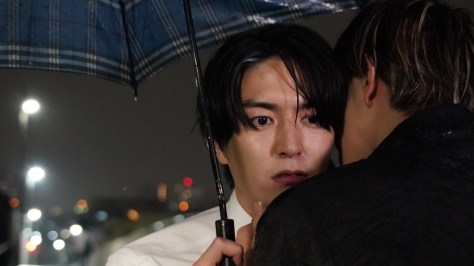
Although Kai is Kiritani’s assumed rapist, the actual rapist in the series is Mamiya, of whom both Kai and Kiritani are victims. This is the reason Kai is so aware of Kiritani’s assault.
Sing in Love is a symbolic film, much like the haikus it refers to. Haikus are a simple form of poetry that, while short, attempts to express a much bigger idea. And that’s what Sing in Love does. It punches you in the gut, remains focused on the punch, and never quite pulls its fist away.
And that’s what makes it both powerful and so indescribably uncomfortable.
There are a lot of apparent motifs, from the abuse of power to the helplessness victims feel, even when they are brave enough to seek help. The police are supposed to be a saving grace, but we are often disenchanted by the lack of support we find when reaching out for it.
This brings me to two of the focal points in this film: fire and rap.
The use of fire in Sing in Love is symbolically all over the place in a way that ties into the movie’s ‘all over the place’ feel. Victims of rape feel ‘all over the place,’ which is why the movie strove to do the same.
Fire has many symbolic meanings, from purification to pain to inspiring passion, which Sing in Love uses. It both purifies and destroys in the film while also denoting how powerful fire can be when controlled and how dangerous it can be when it isn’t.
But, most of all, the fire in Sing in Love represents hell.
Kai is one of the most complex characters written, and Endo Kenshin does an incredible job portraying a young man who wants to save Kiritani while also keeping him in hell with him. As a victim, Kai finds solace in having someone who has experienced the same trauma he has, someone who exists inside the same suffering. He wants to pull Kiritani from the fires of hell while also needing to keep Kiritani inside of it with him.
There’s a lot of lonely agony in being a victim. Rape strips victims of power. It degrades them and leaves them stuck in a nightmare they can’t escape.
Sing in Love keeps viewers inside this nightmare while also giving them an ‘out.’

This is where the rap comes in. There’s nothing professional about the rap in the film. It’s raw. It’s a way to scream into the void. It’s a form of expression that brings a group of people together, like group therapy inside a movie where there doesn’t seem to be any hope.
And that in itself is a reason to watch.
The end is vague. While it seems like the death of Kiritani is real, it also leaves things open to interpretation, which is different from the manga, where Kai is the one to die. The film tries to give viewers something to hold onto.
I won’t recommend this film in the same way I do others. Instead, I will cautiously promote it. Do not watch it if you have sexual assault triggers. Sing in Love does not hold back with any character in the film, including children. I went into the film aware of this and still found myself needing to walk away to breathe. It suffocated me. While I was impressed with what the film wanted to convey, I also want to warn viewers that it conveys it in as realistic a way as possible. This film takes you into the nightmare of sexual assault and never brings you out of it.
I was unsettled, and I was meant to be. Sing in Love is a film that strives to unsettle while offering a tiny window of hope.
It screams into the void the same way the rap does. In the same way that victims do.
Sing in Love is a film with a dark symbolic undertone that doesn’t coddle its viewers.
Rating- 3.5 out of 5
Streaming- Here
 The BL Xpress