
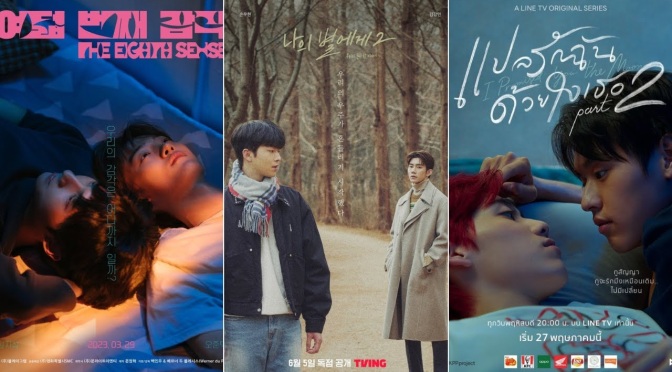
There’s a poetic, artistic, symbolic movement happening in BL filmmaking, one that is shifting the stories we’ve grown used to seeing in the early days of BLs to deeper, nuanced narratives that are slowly taking center stage.
And it’s not only changing how we view dramas, it’s changing how we think.
Gone are the days when BLs offered two choices: fluff or tragedy. Tears or giggles. An entire landscape of stories are popping onto the scene in large quantities. While this can affect production quality, it’s also offering a variety of choices, many of them personally meaningful. Some creators are taking the genre they’re passionate about and exploring thoughts and ideas they’re equally passionate about relaying.
And it’s leaving a trailblazing impression on viewers and the industry.
From political and generational stands with Thailand’s Not Me and 180 Degree Longitude Passes Through Us to mental health issues with South Korea’s The Eighth Sense to the difficulties of balancing a relationship with one’s aspirations and body dysmorphia in Thailand’s I Told Sunset About You and I Promised You the Moon to ageism and gender expectation in Japan’s Old Fashioned Cupcake to the stark reality of facing one’s sexuality in Taiwan’s Your Name Engraved Herein to the pain of understanding oneself in South Korea’s To My Star, the BL industry is churning out powerful narratives that inspire change.
And it’s doing it by artistically expressing itself rather than blatantly shouting.
Symbolism in entertainment is about expressing a larger truth through colors, characters, plots, sounds, special effects, transitions, camera angles, cinematography, and experimental filmmaking. It’s a tricky method that requires time, attention, and a desire to express oneself vaguely while also making it apparent to the viewer. Sometimes it works; other times, it doesn’t. But when it does, it’s powerful.
What all of the examples above have in common is a collective symbolic expression that delivers memorable stories with significant truths tucked inside, like unwrapped gifts that continue to inspire long after the end credits roll.
It’s fun and innovative to see directors and screenwriters take the knowledge they’ve gained in their education, careers, and struggles and put them on screen.
One clear example is the intimate theater feel of Thailand’s 180 Degree the series. Rather than present a typical BL production, director Punnasak Sukee stuck to putting the stage on camera in a visceral onscreen experience that put us on stage with them. And while his history in theater helped deliver a profound experience, it also opened the doors for other filmmakers to do the same. It allows filmmakers to take what they know best and fearlessly express themselves on camera. To fearlessly express the change they hope to be a part of on film.
Another more recent example is the intimate way in which the recent Korean BL The Eighth Sense was filmed using abrupt transitions, color, zoom-ins, and OTS shots to deliver a very personal experience that pulled viewers into a story about grief, trauma, and mental health by taking a variety of film techniques from around the world and meshing it together.
The BL industry is an inclusive, beautiful place to explore, but it’s also becoming a toxic community fighting with itself, from the constant battle between fans who prefer a particular country’s dramas over another’s to the overreaching need to invade the privacy of those involved in productions to the persistent need to attack rather than critique to the wary reception of films and dramas that want to try something new. It’s an industry trying to shape itself while losing its safe inclusivity in the process.
There’s a need for all types of stories, from lighthearted tales to overtly intimate stories to symbolic narratives. And while all of them are fun to explore, I am proud that filmmakers are branching out, that they’re pushing through the sea of voices telling them what they shouldn’t do to offer stories that not only feel personal but inspire people to look beyond the surface, to step into the shoes of the characters they’re watching to understand the pain, joy, and fears these characters are feeling and the persecution they face. These are stories that aren’t often hyped but do often become hot topics/debates where viewers discuss how they feel about certain aspects of the series/film and, in so doing, discover more about themselves and the world. These are stories that don’t always make people feel comfortable, but it begs the question, “Why?” The ‘why’ opens the door to discovering more about topics we may often avoid–politics, generational divide, mental health, trauma, ageism, etc.–and how this plays into the community as a whole.
Storytelling should be as diverse as the world the stories are being told in.
While there are more examples of this than the dramas/films I’ve already mentioned, both past and present, the above are key recent examples of how the power of symbolic storytelling and filmmaking makes its mark. They are prime examples of how branching out and walking a less trod path opens new doors and opportunities not only in filmmaking but in viewership.
Which is compelling inside a fandom that doesn’t always feel comfortable with change.
Each year places the entertainment industry on the cusp of a new change, a transformation that is exciting to be a part of. Voices are getting louder. Stories are getting bolder. Topics once avoided are being explored. Truths are being expressed. And when censorship or traditional expectation makes direct storytelling impossible, symbolic and nonlinear storytelling shines. Art becomes the power to break free of restraint.
And amid that is a growing global fandom that should consider not only the cultures behind the series/films they watch but also the breakthroughs that are happening. The more soft power the industry gains, the more responsibility they feel to shine a light on topics often avoided.
Be expressive.
Be revolutionary.
Be experimental.
BLs aren’t just about two men falling in love with each other but about the power these narratives can hold when given the opportunity.
In a world obsessed with seeing only surface-deep appearances, there’s an entire universe of creativity hidden beneath the surface that isn’t held back by the chains that bind it.
 The BL Xpress
I can (and have) argued both sides of this issue, whether the representation is race, sexual orientation, ethnicity, etc. But there is something to be said for the number of LGBTQ+ directors, crew members, and (probably) actors in BL series injecting their truths into productions. I don’t know how Au identifies, but since he’s worked on a number of projects with Aof, I can safely say he’s a queer ally. MY SCHOOL PRESIDENT would have been just fine without Tinn’s mom being worried about his sexual orientation, the homophobic teachers, and the disapproving adults at the prom, but I think Au didn’t think he could make an authentic story – even if that story is a fluffy fairy tale – without adding those plot points.
And speaking of Aof, he can never be lauded enough. He could direct a fluffy series about privileged guys in his sleep and it would still be good. But instead he is tackling issues such as deafness (MC), poverty (MC), vision impairment (LT), and mental health (Pran’s OCD in OS2: BB) in the context of queerness. What’s the great line from MC? “You’re already poor. Now you’re gay, too?”
LikeLike