
Silence is deafening.
My grandmother was deaf. She lost much of her hearing when she was a teenager during the war in Europe, and even though she wore hearing aids, she still had to read lips to understand what people were saying. When I was little, she used to tell me, “There is a lot of noise in silence.”
I didn’t understand her then, and while I’m more aware of life and what that means now, I may never fully understand the depth of her words.
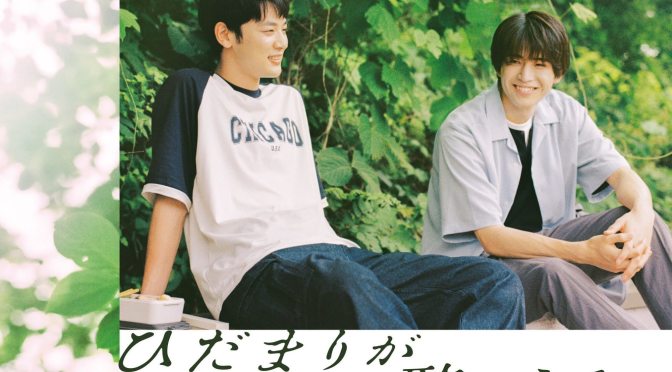
Adapted from the manga series Hidamari ga Kikoeru by Yuki Fumino, the Japanese BL I Hear the Sunspot delves into silence and how starkly loud it can be.
Starring actors Nakazawa Motoki (Sugihara Kohei) and Kobayashi Toranosuke (Sagawa Taichi), I Hear the Sunspot follows deaf student, Sugihara Kohei, as he attempts to navigate university, all while feeling lost inside his own life and the barrier he’s erected between himself and the world. He finds a sudden beacon of light and understanding in fellow student Sagawa Taichi, a loud and outspoken young man whose cheerful and somewhat naive personality is hard to ignore. And also easy to fall in love with.

The first two episodes do a great job setting the stage for the unfolding romantic story by focusing on Sugihara’s sense of separation and alienation from his peers while also highlighting how bright Sagawa manages to be, even as it also gives us a peek at Sagawa’s flaws.
This brings me back to the silence.
I’m an overthinker, someone who worries constantly about my surroundings, about what decisions I should make, and even about the next words that should come out of my mouth. It’s overwhelming at times—the thoughts and many of the reasons behind them.
In those moments when my thoughts are too loud, I remember my grandmother’s words: “There is a lot of noise in silence.” And I think, “How overwhelming must it be to be lost in a world where the only thing you hear is your thoughts?”
While I’m sure everyone who watches I Hear the Sunspot will take something different away from it based on how it makes them feel or even their own experiences, I find that the biggest draw for me is in how loud Sagawa is, not just in words but in his gestures and personality, and how much quieter that must make Sugihara’s world feel.

When Sagawa is around, Sugihara’s world is more than just himself and his thoughts; it’s simply being friends (and more) inside a beautiful world that’s as full of sunshine as it is darkness—a fine balance that makes one appreciate what Sagawa and Sugihara are to each other.
Sugihara is a silent place inside Sagawa’s loudness, and Sagawa is the noise Sugihara needs to escape himself. They are a special place for each other that I’m more than ready to get lost in.
For a series that promises to be as loud as it is silent, check out I Hear the Sunspot now on Gagaoolala and iQiyi. The acting is incredible, the poignant cinematography tells as much of the story as the actors, and the script is poetic. All excellent reasons to tune in.
Rating- 4 out of 5
 The BL Xpress
I am very happy we are seeing the BL world expand to include more varied characters. The first two episodes were very organic; nothing seemed contrived. I think this is a good harbinger for showing us the potential relationship difficulties that can arise when the love that arises from caring for someone / being cared for by someone becomes mixed with a more sexual type of love.
“Last Twilight” explored this well, but seemed to get bogged down a bit by the employer-employee power dynamic, Day’s prickly personality, and Mok’s infinite green flagness. I am anxious to see another director’s take on this issue.
LikeLike