
There’s a delicate line between life and death, one that often blurs into ambiguity.
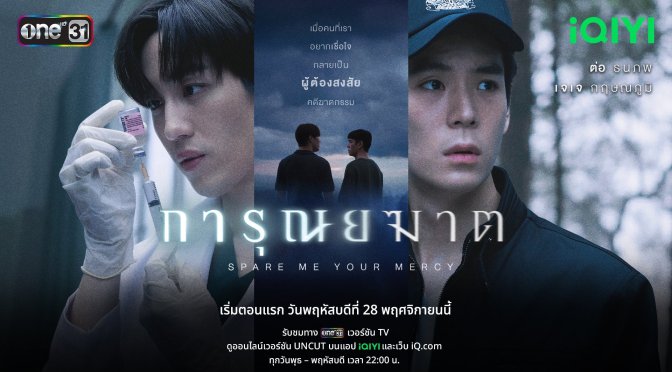
In the melancholic yet romantic Thai BL Spare Me Your Mercy, this fine line is explored through the rising deaths of terminally ill patients—and the mystery of who might be behind them. Adapted from Sammon’s novel Euthanasia, the series stars Tor Thanapob as Dr. “Kan” Kantaphat and JJ Krissanapoom as Police Major “Thiu” Wasan Khambunrueang and delves heavily into themes of love, loss, and the morality of life’s end.
Spare Me Your Mercy is a fast-paced series that devotes much of its first three episodes to unraveling the mystery of who is stealing potassium chloride from the local hospital. Along the way, it cleverly introduces a roster of possible suspects, including Nurse Onanong (Fresh Arisara Wongchalee), Pharmacist Boss Chanchai (Aelm Bhumibhat Thavornsiri), Dr. Rin (Prim Atchareeya Potipipittanakorn), and Hospital Director Somsak (Gandhi Wasuwitchayagit). All while also weaving a deeper narrative that explores the equally suspicious Dr. Kan and the Police Major who finds himself falling in love with him.
There’s so much to admire in Spare Me Your Mercy, from its compelling acting and stunning cinematography to its beautifully crafted plot. But the biggest draw for me is its central theme: assisted suicide.
Euthanasia is a complex moral dilemma inside a world that values prolonging and preserving human life. There are compelling arguments on both sides about why it should and shouldn’t be a part of modern medicine. How we choose to end our own lives has always been an emotional topic, one that tows a fine line that will never be easy to consider, no matter what side a person is on.

And that’s the delicate theme that Spare Me Your Mercy builds its series around. The drama weaves through a spectrum of emotions—pain, affection, frustration, and fear—that easily pull viewers into its narrative. Most striking is the contrast between the deaths of the terminally ill patients, such as the poignant passing of the man Dr. Kan sought approval from, and the desperate escape attempt of another man clinging to what little life he had left. Which subtly hints at two possible perpetrators: one doctor who honors the wishes of his patients and another who disregards them. Where viewers stand on the issue of assisted suicide heavily influences whether they see the on-screen events as acts of murder or mercy.
This brings us to the romance in Spare Me Your Mercy. Despite the heavy plot and limited screen time, the series manages to weave in a romantic subplot—though more quickly than I typically prefer. I’m usually drawn to slow-burn romances that gradually build tension and chemistry, creating a deeper emotional connection that enhances any intimate moments later in the story.
That said, Spare Me Your Mercy makes effective use of its limited time, weaving stolen moments between Dr. Kan and Police Major Thiu to build their romance amid the larger intrigue. A pivotal moment introduces the sparks between them when Dr. Kan confesses his feelings for Thiu, adding that he knows Thiu feels the same. However, this scene is probably my least favorite in the series.
While I understand that the confession was meant to divert Thiu’s suspicions about Kan, it felt disruptive. The stolen glances and simmering tension between the two since the beginning of the series could have culminated in a more subtle yet meaningful moment, such as a spontaneous hand hold or even a stolen kiss. As a published author, I appreciate the power of dialogue, but there’s a delicate balance between when dialogue or action better serves the story. In this instance, a brief, unexpected touch—like Kan reaching for Thiu’s hand and softly asking, “Would you want to go out with me?”—or a spontaneous kiss could have been more impactful. Either approach would have thrown Thiu off Kan’s trail while naturally weaving their possible budding romance into the narrative. The tent scene later could have then been a full confession.

The dialogue used in this scene felt like a forced way to signal to the audience that romance had been brewing, rather than letting actions naturally reveal it. By relying on words instead of subtle gestures, the moment clashed with the series’ otherwise nuanced approach. A “show, don’t tell” approach would have elevated the romance while staying true to the series’ understated yet powerful storytelling.
Despite this, I remain deeply invested in both the mystery and the romance, as well as the secondary storylines unfolding within the plot. It takes a special level of writing and acting to successfully execute an ensemble series that juggles multiple stories and mysteries without losing momentum or becoming overly complicated.
Spare Me Your Mercy accomplishes this masterfully. I am thoroughly impressed by everyone involved in bringing this series to life.
For a show that promises an emotional and compelling journey to its conclusion, be sure to watch Spare Me Your Mercy, now streaming on iQiyi.
Rating- 4 out of 5
 The BL Xpress