

“We knew exactly who we were and where we were going. It was grand” – Quote from Stand By Me (1986)
Perhaps you might be wondering why I would quote something from a 1986 movie of the same name. Because in some way, it is reflective of and harkens back to a time in the past when a friendship between pre-adolescent boys meant something and a lionization of a relationship occurred. Oh, not in a physical sense but certainly in an emotional and perhaps psychological sense, it laid the foundation of a ‘love’ that would develop into a romantic one. Years later, of course. But I am getting ahead of myself.
This is a warm, gentle but not necessarily subtle story of two young men who met when they were young and for reasons unknown, developed an intense and deep attachment to one another and a bond formed that was more than a friendship. Hoang Khang (Tuấn Việt) was trying to cope with the death of his parents and felt lost, isolated, and certainly abandoned. Who comes along but a young man named Quoc (Huy Cao) who befriends him and before long, they become inseparable. The two shaped a friendship that seemed to be unshakable.
Unfortunately, Quoc had to relocate, and a series of miscommunications and misunderstandings prevented him from having a proper closure with Khang. They did not have a chance to bid a final farewell to one another. Thus, anger and bitterness ensued. With Khang feeling deeply hurt and resentful. Most profoundly, however, he felt abandoned, yet again.

Over the next 7 years or so, Khang devoted his time to studying and also helping his Grandma (Nsut Le Thien) with her struggling but steady desert business. Khang has two school friends that he is close with. Trang (Wanbo) is openly gay and recognizes the struggles that Khang is going through to come out as well (especially after his childhood friend Quoc returns). His other friend, Ngoc (Vy Vy) has a crush on him. However, no matter how much Trang tries to tell her that Khang does not and will never see her romantically, she does not want to believe it. Eventually, however, she learns to accept the inevitable.
When Quoc come back after many years of being away from Vietnam, he asks Grandma if he could stay with her. She, of course, eagerly agrees to do so. Quoc has had a falling out with his parents and needs some time to rediscover what he wants to do with his life.
However, rather than greeting Quoc with excitement, Khang completely rejects him. He instead treats him rather shabbily. However, Grandma suspects this is merely a ruse and has known of Khang’s inclinations and his deep affection for Quoc, even though he has denied it.
Grandma tries and succeeds in telling Khang that before Quoc goes back to school that things that need to be said ought to be said and never left unsaid. Otherwise, regret will eat away at you. And she ends with saying that sometimes you need to be a ‘bit foolish’ when it comes to love.
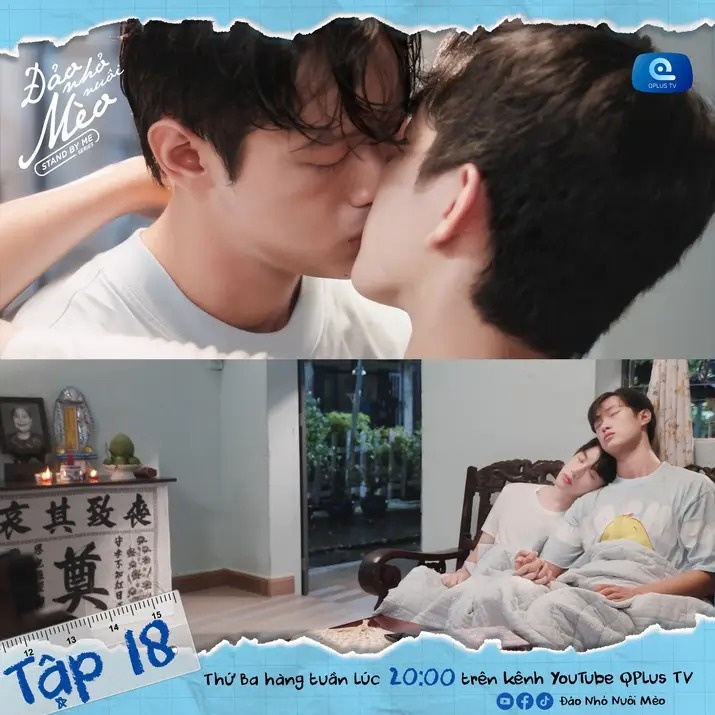
The story itself is not a particularly novel idea, but it is presented, as typical for Vietnamese BLs, with such intense determination and emotion. We understand why these two had and still have such a strong connection to each other. Both developed a love for one another when they were children but obviously, they could not define it as such. Khang felt betrayed by Quoc. No matter what he did or how hard he tried, Quoc could never seem to get past that resentment of Khang’s. The story develops with both humor and a large amount of poignancy as well. Misunderstandings and hurt feelings can become so ingrained in one’s psyche and even though that is not who that other person really was or is, festers and strengthens to overwhelming portions. Khang closed the door to Quoc trying to open it to his side of the story. Grandma and Trang help Khang to open his closed mind just enough.
The saga does go much deeper than mere superficialities, however. As the relationship between Quoc and Khang develops, Quoc’s family, especially his mother, becomes increasingly demanding and controlling. And when she finds out to what extent Quoc’s relationship with Trang is, she really becomes apoplectic. The closeness between her and Quoc becomes completely strained, and he defies her, up to a point. Given the intense familial loyalty to parents, Quoc can never fully divest himself from his mother’s demands. That of course also gives them the freedom to use physical abuse against their own son to force him into compliance. Something that I shall never understand or accept as being appropriate. However, it does not mean he shares their willingness to do so.
What this series beautifully does, is going deeper into the dynamics of Vietnamese family structure and essentially tears it apart. The father (Thien Vuong) who is an astonishingly handsome and distinguished looking man, has always been subservient to the wishes and demands of his wife (Thuy Trang) in order to maintain the peace and tranquility in the house. However, in this instance, he does side with his son by at least keeping an open mind and attempting to see that it is his life to lead and slowly begins to accept who he wants to partner with. To do otherwise, may drive his son further from the family and create a schism that they might be unable to bridge. He sees and understands that his son is committed to Khang, who is equally dedicated to Quoc. Yet neither are willing to do so at the expense or cost of not having an education or a career. Both have made a solemn promise to become doctors and be successful, at the demand of Quoc’s mother and the wishes of Grandma but will remain unflinchingly with each other throughout the process. The father, to his credit, is able to see the complete picture.

Unquestionably, Nsut Le Thien as Grandma was a marvelous recreation of the ideal grandmother. She exuded pearls of wisdom like she was disseminating pieces of candy. She was astute but never overtly so. She senses and knows the struggles that her grandson, Khang, is going through as well as what Quoc is experiencing. Because of her life experiences, she knows when to say things and how to say them without sounding judgmental or sanctimonious. She is also in a society that deeply respects their elderly population and therefore is taken seriously. Yet, Grandma also interjects her comments sometimes with a sense of humor or referencing to when she was younger, making it all the more meaningful both to whom she is speaking to and to what she is actually saying. Literally and figurately, Nsut Le Thien effectively captured this series not only with her charm and wit, but with her grace and her sense of comfort and complete understanding and acceptance of what is going on. She does this so effortlessly that you are lulled into thinking that what you are watching is a reality show. She is commanding the stage with her presence. Families could learn a lot from emulating the understanding and tolerance of Grandma. Kudos to Nsut Le Thien for such a fine performance. This is by far one of the finest performances in a supporting role I have ever seen. You will be moved by her naturalness.
There is indeed a certain level of reality in this series that goes beyond its frivolity. Khang must grow up and face life without Grandma. He enters another phase of his life with a certain stoic acceptance. But he is fortunate in the sense that he now has Quoc, who has promised to be by his side. We get to see Khang become an adult. We also begin to observe Quoc become more realistic and sound in his judgements.
This is an unpretentious story of life and love unveiled transitionally. It is a story of a family struggling to make ends meet trying to run a simple basic desert cart. It is also a story of love between two young men whose seeds of devotion were laid down when they were children, and it was destiny that made them reunite in their love again. Grandma, the rock of strength for both, provided them with the foundation for encouragement and by her very nature, gently blesses their union. Quoc’s family is just the opposite. Perhaps the necessary balance to Grandma’s nurturing ways. They provided a source of hard reality that if they can survive those demands, they can surely survive life. It is almost a story of a Yin and Yang saga of life and love.
What brought this series down just a tad for me is that it did not push the relationship to its limit. Regrettably, all the right words were said, but the actions/emotions to those words were missing. I got no sense, as Quoc and Khang developed, did their physical connection to one another also. It felt lacking and missing and sometimes even empty. They remain infantile and almost prepubescent in their relationship growth. I know that it may be difficult to display affection publicly but not privately. In order for a sense of believability to hit me, there must be a sense of physical connection between two people. Even a longing, a desire. Perhaps sexual tension. All of that was missing and an element that would have made them a ‘couple’ in every sense of that word, was sorely missing in this series. It all had a sense of play-acting. That is unfortunate because so many issues of Vietnamese societal issues were in the forefront to give this series a remarkable and dynamic direction to its story telling. But it became afraid to tackle the one area where we needed to see it. And that is with the romantic needs of these two young men. I know it has been done before in Vietnamese BLs, so it is not a cultural issue but one this production decided to not do, perhaps to make it more palpable. Unfortunately, it stopped the two of them from becoming fully adult individuals.
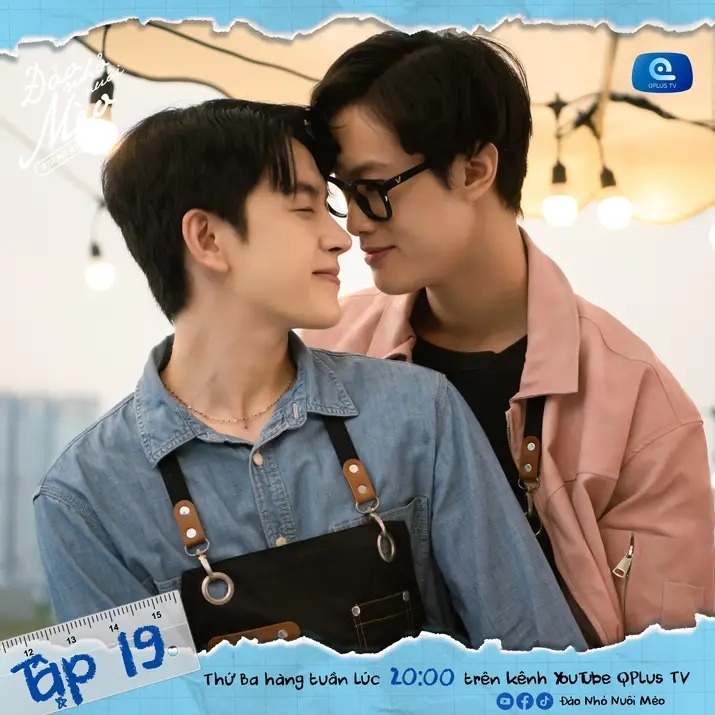
The translations into English are a bit wonky at times and a lot of references to Vietnamese culture and customs went right over my head. Admittedly, there are production issues (sound, editing, cinematography) because of a shoe-string budget and cost controls, but I would match the quality of these series and the heart and soul that goes into these productions against the banal, tropey, pedestrian, cliché-driven BL stories with big budgets. Those hardly ever really ‘move’ me anymore whereas these do.
Perhaps there is nothing award-winning about this series, but it is honest, genuine, and real. As with nearly all Vietnamese BLs, it is also relatable to most of us who live normal uneventful lives. The Vietnamese have a way of capturing the ordinariness of everyday living and make it somehow feel important and can truncate it to a romance. For that, they deserve our admiration. I can relate to ‘pushing a cart’ to and fro as a means of earning a living. That is astonishingly emblematic of the way most of us live and work.
This is yet another winning BL from Vietnam that is cute, entertaining, relatable, and fun to watch.
Rating- 4.75 out of 5
Streaming on- QPlus TV YouTube Channel
 The BL Xpress