
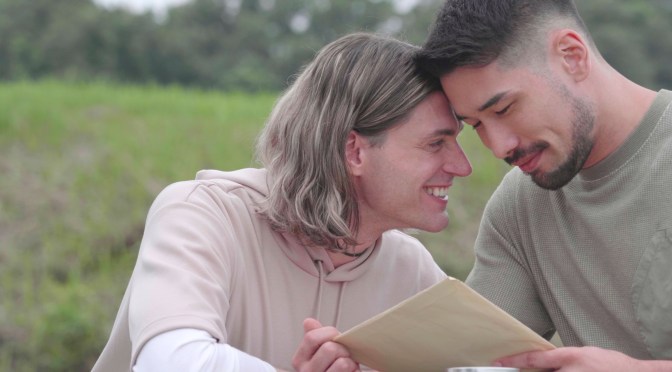
Recently, a connection was made quite surreptitiously between The BL Xpress and Cowboys Tokyo, the producer of the recent gay independent film called AICHAKU. Aichaku, in Japanese means, literally ‘attachment’. Specifically, an attachment to an object that is more like a feeling of affinity – what the object means. It takes on an emotional attachment.
And this movie certainly has that. But the story is so much more deeply involved than merely a story about an attachment to a vision. It is also a quest for love as well. Not meaning to be so initially. Perhaps not seemingly fit as individuals, but when they hewned into a couple, they seemed destined for each other, much like soulmates. This is equally their story as well.
I had a chance to communicate with Chris McCombs, one of the actors, as well as the producer and writer of this unique film. His warmth and openness allowed me to ask unfettered questions to himself and several of the lead cast as well as the directors. Not from the point of view of a film critic but as an individual simply watching this film as an advocate for gay and LGBTQ+ representation. This film unquestionably has heart and a lot of soul.
I hope the interview clarifies areas that seemed unaddressed in the film as well as giving it a greater dimension of what the story was about. For those who have not seen this film, I do hope it creates in you a greater desire to seek it out to watch because it is a very entertaining film with a message that is certainly relevant for everyone in today’s rather tumultuous world.
I watched it on Prime Video but am sure it is on other streaming platforms. Please look for it. We all need to become bigger supporters of independent films especially those who tackle LGBTQ+ issues or stories!
Christopher Nishizawa (Ken)
1. How did you prepare for the role of Ken?
I got a lot of help from Chris with understanding acting for movies and character building. We practiced every week for about three months before shooting. I kept asking questions while we were shooting to keep myself sharp and to stay as true to Ken’s character as I could.
2. Was there any particular scene that you found challenging or difficult?
The kissing scenes were challenging in that it took a whole different level of preparation. You really have to get your mind and body ready to make it look right.
3. The scene where you explain your upbringing to Lucas under the starry sky I found particularly moving. It was interesting how you were detached from the words but I sensed Ken was deeply affected by it. Could you tell me how you felt about performing that scene and how it was performing it?
This scene was an interesting one. It came naturally to me because by this time I had a pretty clear sense of Ken’s emotions. Ken finally got to open up to someone and it felt really good being trusting like that. At the same time, I understood that he’d never been open like that before but somehow it felt completely fine to him. It was a good, fun mixture of feelings.
4. Are there any of the characteristics of Ken you see in yourself?
I’m not much like Ken. I am a very open person, and I like to laugh a lot. When I was younger, I couldn’t express my feelings very well or talk much and really felt like no one understood me. I think that gave me a good sense of how Ken feels in Aichaku.
5. Looking back, is there anything you would want to change or do differently in your performance?
Maybe I did at one point want to do something different with one of my performances in Aichaku, but thanks to the team after watching the finished movie there is nothing I’d change.
Yayoi Fujiwara (Marie)
1. I was not expecting Marie to be so important to the story. I appreciated the surprise. Did you enjoy the role as much as I enjoyed watching you play her?
Yes, I did! It was a lot of fun to play the different sides of Marie. As you can see, how she behaves in the beginning is very different from how she is in the latter half of the film. It almost felt like playing two completely different characters. I liked her from the beginning, and the more I played her, the more connected I felt. I especially enjoyed the scenes where she starts to open up and show her true self — those moments felt very rewarding to perform!
2. How did you prepare for the role?
I had a lot of conversations with Christopher McCombs, the producer and writer of this film. He shared with me how he got inspiration for Marie, which really helped me understand her better. I also felt a lot of empathy for her in general, since I have some things in common with her—like spending my university years abroad and then coming back to Japan. Since Marie doesn’t speak much in the first half of the film, I focused on imagining what she might be feeling in those quiet moments. I tried to express her inner world through small gestures, facial expressions, and the way she carries herself. I also paid attention to how her tone of voice and body language could shift as she reveals her true self throughout the story.
3. Your comedic timing is very good. Do you enjoy playing comedic roles?
I’ve always loved making people laugh ever since I was a kid, so playing a character like Marie was pure joy for me. I had played comedic roles on stage before, but this was actually my first time acting on camera, so I was a bit nervous at first. But the team made me feel so relaxed on set, which really helped me stay natural in front of the camera.
4. Are there concerns about taking on a role where you might be labeled as being lesbian? Or is that something you didn’t worry about?
I didn’t worry about it. For me, the most important thing was the character. That’s what I focused on more than anything else. I believe it’s essential to portray characters across the spectrum of sexual orientations and backgrounds with empathy and respect. My goal was to bring honesty to Marie and make her feel like a real person. I hope that came through in my performance.
5. Would you like to see a second movie about Marie and her partner perhaps with your mother visiting for an extended period in the US?
That would be wonderful! I’d love to see Marie explore more of herself and find love in the US. I also really enjoyed doing scenes with Kaori Takeshita, who played Marie’s mom, Yoshiko — it would be such an honor to work with her again. And of course, I’d be thrilled to work with the same amazing team. They created such a supportive and creative environment on set, and I feel very lucky to have been part of it.
Koichi Sakaguchi (Nobu)
1. Your part stood out the most for me in the movie! I found your tough exterior hiding someone more nurturing very interesting. Why do you think Nobu didn’t show Ken that side sooner? Was Nobu waiting for Ken to finally be himself?
Nobu himself didn’t understand Ken, and he had a strong belief that the only way for Ken to be happy was to work together to support the company, so I think he didn’t try to understand Ken’s struggles. Therefore, when Ken finally opened up about his hardships, Nobu realized for the first time that his own strong beliefs had been hurting Ken. I think that’s the sign Nobu was waiting for.
2. Do you think somewhere inside of you there is a part of you that is like the character Nobu?
Like Nobu, I have a lot of love within me. I sincerely wish to let that love lead me as I live.
3. How did you prepare for the role of Nobu?
Most of my preparation was done simply watching Chris perform as Ken. He’s such a hard worker and really is happiest giving it his all. Like Nobu, I just kept an eye on him from behind and sent him positive thoughts and positive energy even when he was getting his makeup done or on a break. I’m sure it was a bit annoying for him just like it probably was for Ken.
4. In Aichaku, Nobu had a chance to meet Lucas’ mom Cathy. Do you think there might be a potential romantic plot for those two characters in the future?
Nobu inherited his brother’s company and seems focused on that. I don’t think he has time for anything else, but love is mysterious! With love anything is possible.
5. Your acceptance of Ken deeply touched me as a viewer. There was something profoundly moving about your hugging him that made me feel you understood him. Did you draw on something personal for your performance in that scene?
I’ve had friends and family who have confided in me the way Ken did with Nobu, and they were very profound experiences for me. As I get older, I’m more and more grateful for those experiences. Before we shot that scene, there was a moment when I thought about those people and those times. I’m really happy if that sentiment came through the performance.
I also thought of a couple of arguments with my wife that ended similarly. (Just kidding.)
Christopher McCombs (Lucas/Producer/Writer)
1. Did you find any scenes unusually challenging or of particular difficulty?
On day three of the movie Ken and Lucas have an argument outside of the English language school. It was VERY hot out, and we were losing light quickly. We couldn’t go too intense because BL movies aren’t really known for their social messaging and that scene needed to fit in tonally with the rest of the movie. We couldn’t take it too lightly though because there are many people with visas and immigration issues in the world and it’s also the core of Lucas’ story. Between that balancing act, the time crunch, and the heat that scene really stands out to me as challenging.
2. How did you prepare for the role of Lucas?
When writing the script, we took a lot of time to speak with LGBTQ+ foreigners living in the countryside of Japan as well as foreigners working at English language schools based out of small towns. I’ve only lived in Tokyo, the isolation they described I had not experienced. It was very informative. I also had a lot of rehearsals with Chris. We were determined to get Ken and Lucas right and I think the time we spent together really paid off. I really enjoyed that time getting to know Chris and Ken and it will remain a very special memory to me.
3. Do you have any personality traits of Lucas?
Like Lucas, I have a very complicated love affair with Japan. It’s not easy living as a foreigner in any country and visas are very cold hands to hold. Having said that, I’m a lot more gritty than Lucas is. You’d never catch me sitting in the middle of a country road pouting. My mom still sends me underwear from Kohls though, so we have that in common too.
4. I have always wondered if kissing scenes are difficult or uncomfortable to film?
I think it has a lot to do with how the scenes are filmed. By coincidence, we had the kiss scenes scheduled to shoot in the same order they are in movie. Ken and Lucas’ first kiss was our first time kissing in real life too. It was raining, it was about 2 in the morning, and we had been shooting nonstop on location for days. I think that helped inform that kiss though. It was intense and felt almost frantic. For the last kiss on day three outside of Ken’s house, it was Chris’ last day of shooting and by that point in time we really had a sense of how Ken and Lucas fit together. There was a beautiful full moon and a light summer breeze keeping us cool. It felt right for the characters and I’m really proud that we were able to get that very pure and intimate kiss for Ken and Lucas when the story called for it.
5. Lucas seemed exceptionally attached to the restaurant. Do you personally have your own ‘Aichaku’ you are striving to obtain?
I love America very much, but I’ve lived here in Japan for 16 years. My home is here. I’d like to stay. Immigration is not a simple conversation though. Comparatively, Lucas had it pretty easy with his cafe.
6. As the writer, where did you get your inspiration for the script?
I was very inspired by a lot of the hopeful, optimistic LGBTQ+ films that have been coming out lately, especially in the BL genre. I don’t care if it’s cliché, feel good romcoms and dramadies have an important place in the entertainment rainbow! I wanted to contribute to that and shine a light on some members of the LGBTQ+ culture in Japan that I hadn’t seen get a happy ending yet in Japanese films as well. Seeing yourself reflected in a happy ending matters a lot!
7. Money is of course always an issue when producing a film. How do you go about trying to get funding for this type of movie?
As a production company, Tokyo Cowboys made a lot of connections and allies with our television series The Benza and travel documentary series Getting Dirty in Japan. We turned to a lot of these people when we were in preproduction to ask for support. Additionally, my friend Max Emerson was kind of enough to help us through postproduction when we were running out of financial steam by allowing us to be a part of his crowd funding campaign for his latest novel. I don’t know how we would have made it through postproduction without his support.
Riato Nishizaka and Michael Williams (Directors)
1. One of the issues I had with the movie was the disconnect of the first half of the movie with the second half. Why was it not made clearer that Lucas could speak Japanese earlier than he did?
Michael- We wanted to showcase the reality of living in Japan. Often people will launch into English when seeing foreigners without thinking that we might understand Japanese. I think a lot of people who haven’t been to Japan don’t know that it is a common thing that happens here. We tried exploring that specifically with Lucas in the restaurant scenes.
Raito- I think it was important to show what Ken and Lucas’ day-to-day life was like in the beginning of the movie. One of the English teachers we interviewed said that he could go a whole day without speaking Japanese even though he lived in Japan and no one would even notice. I’ve never seen anything like it before in a Japanese film. That really stuck with me and I’m glad we could use it in the story.
2. Overall, the movie is presented in a genteel almost meditative tone. So much of it is emotionally delicate, especially when Ken tells Lucas of his background. Was it hard to maintain that kind of delicate emotional balance throughout the movie?
Michael- I think one of the most important things was to let both of the actors sit and feel out the script by themselves. If we had given them a long list of very specific notes, it wouldn’t feel anywhere near as natural as it does in the film. Both Chris’ impressed us with how it was clear to see the emotions on screen so naturally.
Raito- We really considered how to convey the necessary messages without overdoing or underdoing the emotional performances, action scenes, and camera work. Although we did not have a large budget and were limited in what we could do, I believe that the actors and staff worked together as a team and did their best to maintain the tone of the film.
3. What was the most difficult scene to direct and why?
Raito- The scenes we shot on the first day of filming might have been the most challenging. Tokyo Cowboys usually works with the same actors for our dramas, but this time, we cast most of the actors through auditions to match the script. With so many new cast members, it took time for us to develop the delicate interactions needed for the scenes. As communication on set gradually improved, filming became smoother over time.
Michael- One of the more difficult scenes would be the fight between Ken and Ryouske. We knew we had show Ken fighting, but we didn’t want the audience to think of him as a bad person for doing it. Striking that balance of showing the action but also justifying it was a challenge, but I believe that we succeeded in the end.
4. How much of the movie was filmed in Chiba, Japan? And how was your reception to having a movie made there?
Michael- Almost all the film was shot in Chiba, there are only two or three places I can remember that were in Ibaraki. I loved being out in the real countryside, rather than trying to fake it. I think that comes through especially with the sound. The Japanese countryside has such a unique soundscape compared to the city. Especially in the summer with the insects buzzing instead of cars and sirens blaring.
Raito- What made me happiest was that the local film commission and others who helped with the location shooting really liked the movie and felt proud of their hometown.
5. I loved the ‘Aichaku’ pull to the theme of this movie and want to see more. Can we hope to see more like this from the two of you or perhaps even an Aichaku 2?
Michael- Raito and I will be collaborating again later this year with Chris on the third and final series of The Benza which is also available on Amazon Prime Video and Tubi. We also have an outdoor adventure series that is set in Japan called Getting Dirty in Japan!
Raito- We’ve discussed the possibility of an Aichaku 2. Chris already has the outline for a story that would follow Marie in America with Ken and Lucas joining her for a visit. It would sort of be the opposite viewpoint of Aichaku with a Japanese person in rural America. I don’t know how possible it would be to make, but there is a story ready to go.
WHAT DO YOU WANT THE AUDIENCE TO GET FROM WATCHING THIS MOVIE?
Christopher McCombs- I hope people walk away from Aichaku feeling happy and optimistic. There is still love and hope in this wide world of ours. We mustn’t give up on our dreams, and we mustn’t give up on the idea of happy endings. Sometimes you might have to fight for it, but they are certainly all still out there waiting for you to find them.
The BL Xpress would like to express our gratitude to “Team Aichaku” for this wonderful opportunity!
 The BL Xpress