
“What happens to it all? All the sounds released into the world never captured?” – ‘Quote from The History Of Sound
The movie feels strangely different; like it ought to be true. It has such an authenticity about it that makes you feel you were watching actual events. You are not, of course. It is all fiction, yet it serenely feels so honest. More than that, you become a participant in its world. There is a love story but one that you do not realize how intense, until the end. Then you grasp to what degree a love between two men was that could not be realized and how impossible it was to even be entered into within their existence. It was unachievable.
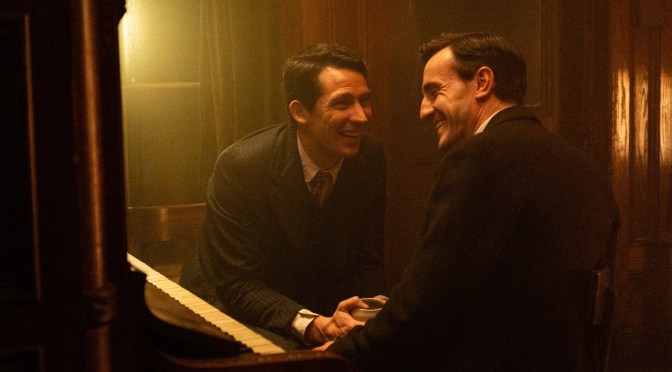
Transport back to a time unknown to all of us. It is around the early 1900s, and one lives in the rural backward area of Kentucky in the United States where abject poverty is the norm. Divine Providence gave Lionel Worthing (Paul Mescal) a beautiful voice. With that voice, he was sent to the New England Music Conservancy for training and education and was able to transcend into becoming a musical prodigy. Now as a young man in 1917, he serendipitously meets another young man with a real gift for music as well. He can recreate the melody by listening to it once and remembers the words. His name is David White (Josh O’Connor) who immediately captures Lionel’s attention not only for his musical skill-set but also for his wit, charm, and natural charisma. Indeed, there is a quietness about their attraction and obvious union which does not in any way call attention to the intensity of their passion.
However, the narrative does not concentrate on their passion and is only presented in fleeting moments during the brief time they are together. In all honesty, this is not so much about their acts of love but more so around their legacies each left behind; not so much with the world but upon each other. This is a story deeply about two men who found each other, loved one another, and then tragic embodiments of experiences shortened it for one, while for the other it created a lifetime of wistful memories and longings for once was – perhaps always trying to understand the reason why.
This movie is mesmerizing for its beauty and haunting images of what life was and for painting impressions of what life must have been like. I cannot remember the last time I got such an integral visualization of what a time in history was like as this film showed. It laid out how one had to get through a world war, an economic depression, living in poverty, and rising to an established level of success. And yet still not be happy. Feeling as if something is missing from your life; coupled with a sense of emptiness. Seemingly always harkening back to the time when you traveled primitively through the mountains and hills of Maine in the United States to record (then on clay cylinders) the folk songs, spirituals, and melodies handed down through generations by those listening to their kinfolks singing the melodies. A background that would have been forgotten. The songs that were indeed the heart-and-soul of early America. If you want to understand the history of the United States (and not what it is now), this is your movie. It shows what life was really like for those that had and for those that not-had.
I would label the actors’ depictions of their protagonist characters representative of a ‘laid-back’ acting challenge. That does not mean to imply they did not act well. On the contrary, their acting was exceptional, given that neither one was even an American. They pulled off the ‘American mythos’ rather well. Besides, the age is the period between 1917 through the 20s when the world was at a different time and place in terms of decorum, mannerisms, and expressions, with formal education being continental. However, one role does stand out for me that, while briefly present, is pivotal. She is Belle played deftly by Hadley Robinson. Her capacity is not for me to divulge but for you to assimilate. Suffice to say, Belle, in her deferential role, keeps the entanglement between David and Lionel to herself. For a woman in that epoch to keep such a secret is remarkable on so many levels. She could have used that disclosure for either her good or for other’s ill. She chose to remain silent. To me a peerless example of fortitude. She is a prime example of taking life in stride and of acceptance and maybe understanding; but what other choice did she truly have? We can only imagine what her internal pain level was like, which she was required to bear alone. I found Hadley’s portrayal of Belle remarkably subtle, raw, and so evident for the era she was in. Her life was hell and there was little she could do about it. It was written all over her face. It was the face of reality.
You must watch this movie in a figurative sense, not literal one. By that I mean, while the cinematography of this movie is breathtaking, it is too picturesque. While David and Lionel are wandering around the woods of Maine during the winter, they are living in a tent with mild weather conditions. This is a fantasy meant to be representational. Anyone who has been to Maine, even during early Autumn, knows how bitter cold and snowy the conditions are. All the characters they met along the way looked reasonably clean, which would NOT have been the case during this period and time of year, either for our protagonists or for the individuals they were recording. (Remember, they had no access to showering and little to no bathing or changing clothes regularly). Lionel’s house, while primitive, looked only merely substandard. In those days, homes, especially poverty-stricken ones, were way, way worse. Imagine.
The love chronology is infrequently shown and to a degree not its main purpose. The story is Lionel Worthing’s reflections from much later in his life with an intrinsic grasp of the effect he now realizes David White had on his life that one only understands as one gets older. He remembers snippets of their intimacies, and only he distinguishes its gravitas on him. We, as an audience, cannot nor should not know what that is. They only knew each other briefly, but their bond lasted a lifetime.
Nevertheless, the center point of this story is about sound; specifically, the sound people make with their voices – singing.
I cannot tell you more about this movie without ruining its impact on how you see and perceive it. While the story is uniquely American, its message is universal. It is a mixture of two individuals who fall deeply in love with one another because of a shared mutual passion. They were, just in a blink of an eye, able to intertwine that passion and love together with intimacy. That rarely happens in life, and I think Lionel recognized that. Perhaps that is why he finally saw his bind with David not as nostalgia or grief but merely as the ‘hardness of fact’.
Let me leave you with the song that originally ensorcelled them. The words are haunting, and its melody reflects the untenableness of their love and also mirrors the pain and hardship of life for many, many people who struggled during those difficult early years of the settling of the United States:
“Don’t sing love songs; you’ll wake up my mother.
She’s sleeping here, right by my side.
And in her right hand, a silver dagger.
She says that I can’t be your bride.
My daddy is a handsome devil.
He’s got a chain 5 miles long.
And on every link a head does dangle
Of another maid he’s loved and wronged.” – ‘Silver Dagger’ Song
(Try to seek and listen to the song – it is a stronger reflection of what was the United States than is today).
This is a deeply pensive, reflective, and dark yet poignant, meditative, and ruminating movie all at the same time. About a love that could never be and a music that was nearly lost. It is an exceptional account of life long forgotten but needs to be remembered.
It is one of the best movies I have seen this year, no matter its genre.
I would encourage all who watch this truly inspiring movie to not just concentrate on the theme’s darkness, or its melancholic sense, but to reflect also on the essential question of what really happens to all the majestic sound when we sing out loud, be it by ourselves, in a group, or just intimately with one other. Where is all that sound going? Where do we want it to go?
Rating- 5 out of 5
Streaming on- Prime Video
 The BL Xpress