
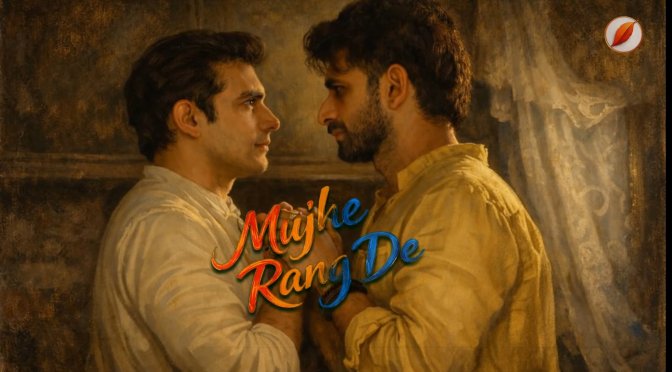
Loosely translated, the title of this series means ‘Color me’ and that is an apt description of this mosaic enterprise as it is a mixture of human drama along with a vibrancy of artistic expression. I hesitate to label it as a BL because it is clearly not; yet it is a love story. The protagonists are adult gay men navigating societal norms and challenges that stem from enduring repressive attitudes regarding acceptable sexual behavior in their contemporary world. This is a story of two men who fall in love while facing societal judgments about their relationship. For theirs is a society that is hardly ‘open’ to having two men fall in love and even more intolerant of them staying together. The story is honest, blunt, and full of pain. Oh, their pain is insidiously underwhelming, which makes it perhaps even more acute. What would or could overcome the pain? Love.
Shikhar (Garvit Ahuja) is an ‘out’, ruggedly handsome man who is a commercial artist and painter. Over the years, Shikhar has closed himself off from love. Although he has many sexual encounters, intimate relationships and love are not something even being considered by him and is a construct for the bourgeois. Yet his whole persona is one of almost encompassing sadness. His best friend Meera (Juhi Arora), who by her very nature is accepting and open-minded, is dating a man named Agastya (Chaitanya Vyaas) and has been for a while. Meera is exotically beautiful, while Agastya is arrestingly handsome with a boyish, almost innocent face. Shikhar had always felt that something was a bit off with Agastya and one day, while scrolling on a gay pickup website, inadvertently realizes that Agastya is gay. Deeply closeted but nonetheless, wanting gay sex.
While not feeling this is within his wheelhouse nor is it in his nature to tell Meera directly, he does reinforce the doubt in her mind, which she had already surmised. She senses and feels that Agastya is in a ‘different place’ than her and to continue in a relationship with him would only prove in the long run to be disastrous. The thought had crossed her mind that Agastya might even secretly be harboring gay tendencies. So, Meera boldly decides to end their physical relationship. Still, both have this unique bond of love between them that is unshakeable.
Because of a business arrangement, Agastya and Shikhar are forced to be together to complete an art project for a client. Neither wants to, yet both crave it – secretly. Here is where a bond begins between the two. But it is an attachment that affixes four different levels of love. And a whole world of pain and sadness is exposed. Pain and sadness that is so deep that it clouds rational thinking and behaving.
This is obviously not your typical standard ‘BL’ set up with silly high-school or college students suffering from pre-pubescent syndrome. These are adult men, struggling in a society that is less-than-accepting. One may be ‘out’ but that does not mean he is completely immune to the hurt of those who are embarrassed by him. Shikhar’s own mother is married to one. After his father died, she marries a wealthy provider, which now has caused a rift between them. There is something so extraordinarily painful about a schism between a mother and son that is wounding and abscessing to a son who had grown up wrapped in a mother’s love. The sting of rejection for Shikhar runs deep. So, this becomes a story of mending a love between a mother and her son. Love number one.
It becomes obvious almost immediately that a sexual tension exists between Shikhar and Agastya from the moment they are in the same room. We can sense that Agastya is attracted to Shikhar and in a way that is nearly imperceptible but not to Shikhar. Shikhar is attracted to Agastya much more than if he was just another one-night stand. Through skillful screenwriting, impeccable directing, and nuanced acting performances, Shikhar’s evolving affection for Agastya is portrayed with measured depth, while Agastya perceptively recognizes these subtle shifts. But when Agastya passionately kisses him as a sign of completely giving in to his emotions, we see Shikhar pretend to be unmoved by it and say to Agastya do not ‘romanticize’ what they had. Both quietly go off in different directions with tears – unfeigned tears of pain. It is obvious that they are, not singularly, but both deeply in love with one another. Arduously and unmitigatedly. Love number two.
However, with Shikhar, there is an outstanding love. A stronger love. One of loyalty. A love of friendship for his friend, perhaps his only close friend he ever had. He knows and has been told that while Meera has broken off with Agastya, she still loves him deeply and cannot handle the thought of him being with another. She has also come to realize that she knows Agastya is in love with Shikhar but cannot bear the thought that they could be together, as she knows that Shikhar is not sincere with any of his connections. Perhaps she did not intend for her statement to be so intrinsic or heartfelt, but Shikhar internalized it all and was willing to give up his love for Agastya for his love for Meera, as her friend, his sister. He assures her that a relationship between them will never happen. Love number three.
Finally, we have a special and beautiful bond between Agastya and his own mother, who is more accepting and beyond saintly. She has known all her life that Agastya is ‘different’. Her primary concern is her son’s well-being, and she is dedicated to supporting him as he works toward self-acceptance. In other words, she has dedicated herself to supporting/nurturing him. Having met Shikhar plus her own maternal instinctual senses, knows that their relationship is the best for the two of them. Love number four.
The bedrock of this series is pain. Lots of it. Shikhar hides his pain with bluntness, pointedness, and a stand-off attitude. If one does not love, one will never assume pain. For relations always end poorly. Love is equated to and with anguish. Meanwhile, Agastya struggles with his own internal pain of acceptance and tries to cover it up by pretending to be ‘straight’. Although his mother accepts him, he cannot accept himself. To make matters worse, he falls in love with an individual who does not believe in love. Meera’s pain is inadvertent but maybe the most devasting. While not meaning to be so, she made Shikhar feel as if he should not love Agastya because it would be like deeply wounding her. While she severed an ongoing physical relationship with Agastya, she had not emotionally separated herself from him and neither had he. They remained intrinsically tied to one another but on two different levels. Agastya thought of her as a sister, while Meera was still remaining with him as a lover, emotionally. Although irrational, she permitted her intrinsic love for Agastya to cloud her, seeing the physical, emotional, and intimate love and needs that Shikhar had for Agastya. Until she saw his pain and realized what she had done.
Finally, this story ends with redemption. Nobody here is bad. Just a human – who just needed to realize before it became too late that there is a better way to convey “I Love You” without conditions or restrictions to it. The level of regret and pain ended.
This is a flawless series. Adult in content as it deals with adult issues. We see love through an adult lens. Real people with real issues. Their acting is flawless. There are no pretenses to whom each character is or what they represent or what they want. They are imperfect- much like us. This series is a narrative about adults trying to cope with being gay and developing a relationship in a world that is not very accepting of either of them or them being together. Beautifully representational and executed with unblemished precision.
One of the best for this year and no doubt a strong contender for the number one spot for best series for this year, no matter what it is labeled as.
Rating: 5 out of 5
Streaming on- Last Leaf Pictures YouTube Channel
 The BL Xpress