

It is not fortuitously that the public considers Priest one of the best light novel writers at present. Sha Po Lang is a worthy reading, that won’t make you waste even a minute in the case that you decide to give it a chance. While reading, in many moments, I was unable to stop because I was too curious about what would happen next. The only solution was to keep reading to discover it. It was very thrilling!
Sha Po Lang’s story is about Gu Yun, the most prominent but very young (19 years old) Marshall of Great Liang, and Chang Geng, a twelve-year-old countryside boy who is a long-lost prince. They meet, become family, and, afterward, lovers. Together they will grow up, mature, start a love relationship and save the country from foreign invaders.
What makes this book different from others is the balance among all aspects of the plot: politics, wars, and romance. The biggest plus is how smoothly Priest pushed forward the plot development, making all themes advance in harmony. She didn’t forget any character, so you won’t feel the supporting ones were put aside handily and made no contribution to the plot. Here, everything has its place. Also, the reader won’t find politics more relevant than romance or vice versa. Neither will feel that the couple got together quickly and for no good reason. Problems that I usually find in many other danmei books.
Also, the political plot was thoroughly thought out and executed. We can find a parallel between the fictional Great Liang’s use of ziliujin – a mineral used to turn on powerful war machines and robots – and the current international relations among countries around nuclear weapons and resources.

Great Liang is a rich and powerful country, but its territory lacks ziliujin. In this way, their military forces face an obstacle to increasing their wealth and sizing more territories by direct conquest. On the other side, the neighbors’ countries lived in fear of Liang’s army, mostly fearing the division led by Gu Yun. It is like that because they couldn’t develop a similar technology to balance their enemies’ military equipment and robots to make their own countries progress economically.
Therefore, they move their forces to the borders aiming to harass and rob Liang’s cities. In that way, oppression and resistance are two sides of the same coin. So, without surprise, the neighboring countries allied with western countries to defeat Great Liang’s Emperor. In this scenario, a new character reveals his ambitions: the prince Yan Wang. It is the young prince Chang Geng (or Lin Min – when he assumes Lin’s last name).
Becoming a key piece in Great Liang’s resistance against external enemies, Yan Wang tries to carry out his goals regarding a comprehensive government reformation. At the same time, he manages to support and protect Gu Yun on the front line of the war from the imperial court. Then Priest managed to discuss some old political practices and criticize the imperial times, showing her readers that developing commerce and creating new technologies are as relevant as conserving the scholarly heritage and values.
In parallel, and after going through life and death experiences, Gu Yun starts to understand Chang Geng’s feelings toward himself and his ambitions as a prince. Slowly, the prideful Marshal accepts both sides of the intelligent and resourceful prince, and with it, they become a couple in private and partners in public eyes.
Another central aspect of Sha Po Lang is how Chang Geng managed to control the poison Bone of Impurity. Indeed this poison makes him lose his temper, and it can make CG go crazy in the future. Priest sized the Bones of Impurity issue to present us with a discussion about who is the real monster when it is about the country’s administration and survival. The reader can confront Li Min, and his Royal Brother (Li Fei) approaches related to imperial affairs and issues, so decide the answer about who did lose to their inner monsters.
This situation becomes a sword over the head of Chang Geng. It is pretty sad because he already must carry many traumas from his childhood and enormous guilt because of his feelings about his yifu. When Gu Yun accepts and supports Chang Geng, the boy finally finds a bit of happiness for himself, and we can see how Gu Yun himself becomes more mature and tender. For me, at this point, the book became undroppable, and I finally couldn’t stop reading until I finished all the main story’s chapters.
In summary, it is the existence of possible intersected questions and further reflections that makes Sha Po Lang becomes a gratifying reading. Also, because Priest is a skillful writer, we can enjoy each chapter unvaryingly, without feeling bored even for a short moment.
Rating- 4 out of 5
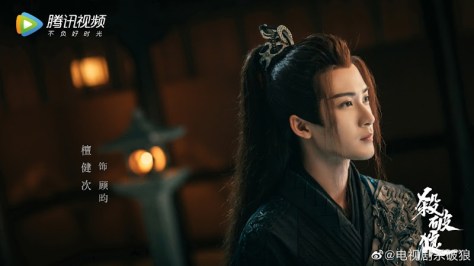
(Picture Source- Official pictures from the adaptation Winner is King)
This article is adapted from Ideas and Words which reviews asian movies, series and animes!
 The BL Xpress