
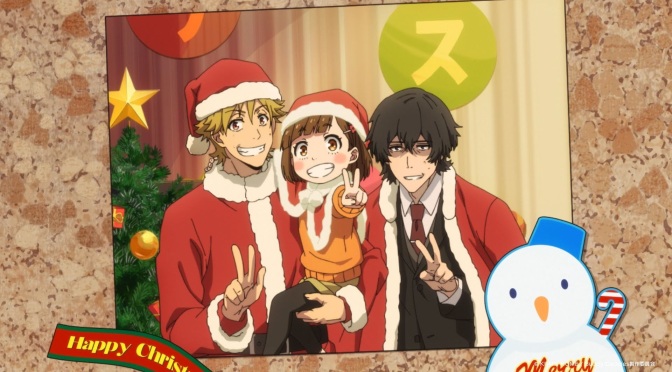
In Hindi, we have a saying, samajhne wale samajh gaye (the ones who needed/wanted to understand have understood).
Buddy Daddies trudges the boundary between what is openly BL and what is not, it has queer themes but is subtle enough to bypass those who are still unfortunately not accepting of openly Queer individuals and families.
The plot deals with Kurusu Kazuki, who is your average Casanova, using his charms to flirt with and seduce women. His partner and roommate Suwa Rei, on the other hand, is the brooding homebody to Kazuki’s outgoing and bubbly self. Oh, and they’re both assassins.
In a mission gone wrong, they come across Unasaka Miri, who has been abandoned by her mother and is on the lookout for her father, the same father they have just successfully assassinated. They decide to take her in even if they are not prepared for what fatherhood may entail. The rest of the show is a slice of their life, co-parenting Miri while trying to navigate their jobs as hitmen, and also trying to protect Miri and each other from Rei’s hostile father and his assassin minions.
Buddy Daddies may not be Queer, if you think of them being Queer in terms of their identities, and them being in a romantic relationship with each other, because the show never outrightly states they are, but it is definitely queer as in disruptive of the heteronormative ideal of the family. Kazuki and Rei never shy away from acknowledging themselves as Miri’s fathers, and neither do the rest of the characters. Their family dynamic is not played for laughs, nor is it ever diminished in favour of the action sequences. As much as Kazuki and Rei are assassins, they are also Miri’s papas, they try hard to raise her and they are proud of it.

While the show was airing, there was one question that was going through everyone’s minds- is it BL? I don’t think I can answer that question to be fair. I have my own ways of reading the media I consume, and other viewers may disagree with me.
BL as a genre has gained immense popularity over the decades, and especially so in the past few years. However, it still faces derision from a big section of the population who don’t consume it. I could go on and on about the misinterpretation of BL as ‘fetishistic’ of gay men, and the undue judgment that is meted towards it, but let’s no go there. This is not about my feelings towards BL in general, although Buddy Daddies’ plot, creative decisions, and reception by audiences, do bring it in the ambit of discussions about BL. Whether or not it is BL, I read the themes and symbolisms of the show as definitely queer-platonic, if not Queer.
As the show was airing, I had more than a few conversations with friends who were convinced that there was nothing Queer about the show, Kazuki’s proclivities with flirting and being with women were overtly mentioned in the show even up until the end, and they were of the mind that Kazuki and Rei were simply buddies who were also daddies.
On the other hand, I also noticed signs that could be missed by those not looking into them deeply but obvious to those watching it with a queer perspective- such as their handler Kugi Kyutaro ‘Kyu-chan’ telling Miri that Kazuki is a comedian and Rei is an oil baron, and her drawing them as wearing a black tux and a white thwab (robe) and with a kaffiyeh (headdress) that could be mistaken for a wedding suit and a wedding gown with a veil. It was a deliberate decision to include that joke leading to that unmistakable imagery, and I wasn’t the only one to discern it, if my timeline was any indication. Kyu-chan also at another point them warns them of the pitfalls of raising Miri while being assassins, as the world would not look kindly upon them as a family because of who they were. The queer metaphors are kind of hard to miss.
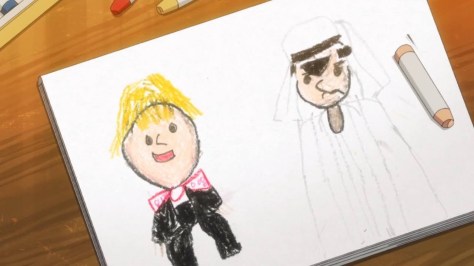
These queer aspects are subtle enough to go over the heads of the ones reading it through a heteronormative lens, thus giving them a fun (albeit not including all the heartbreaking scenes in the present and the past) slice of life comedy (when it’s not filled with the sad bits) of two buddies who are also daddies.
Whether you read it as Queer, as queer-platonic, or simply as a buddy comedy where they are strictly heterosexualTM, Buddy Daddies is something I highly recommend to everyone.
Rating- 5 out of 5
(I have differentiated between Queer with a capital ‘Q’ to show Queer identities such as identifying as Queer, or being in a Queer romantic relationship versus queer with a small ‘q’ for anything that doesn’t conform with or disrupts the heteronormative)
Streaming on- Crunchyroll


Where to watch/stream this? Wish the article mentioned that information.
LikeLike
Not mentioned in the article, but I found it (in my area) on crunchyroll – https://www.crunchyroll.com/
LikeLike
It is mentioned in the article too.
LikeLike
This definitely looks intriguing. Coded bromance but entertaining aka Word of Honor? I’m in !
LikeLike