

“A man and a woman can be friends; they don’t necessarily have to be queer for that”
The movie version of Park Sang Young’s novel adaptation projects a strong message that subjugates most societal norms and outdated beliefs. There is a clear demarcation between the movie and drama version; so you might be slightly disappointed with the conjecture. For those who are unhappy because the movie gleams too much on the friendship aspect rather than tackling the issues concerning the queer community; we have an important reminder. The movie is based on the first few chapters of the novel where the main protagonist lives with his sassy best friend. The drama version follows up on the later chapters where he tackles personal issues and inevitably meets the “love of his life”. Some scenes in the movie seem to clash with the content in the drama series, but that’s bound to happen when there are directorial differences.
Synopsis-
Characterized by her sharp tongue and daring attitude, Jae Hee is always at the center of gossip and hateful rumors. Meanwhile, Heung Soo is set on keeping his gay identity a secret for life. One day, in the back alley of a hotel, Jae Hee discovers Heung Soo’s secret by chance. Contrary to Heung Soo’s worries, Jae Hee keeps his secret and even helps him in a critical moment. As the two misfits begin to rely on each other, they secretly move in together and attempt to find love in the prejudiced world they live in.
(Source: Plus M)
As against the drama version which is an audacious tale of two roommates, one a gay man, Ko Yeong and another a straight woman, Mi Ae, the movie version circumnavigates around Koo Jae Hui (Kim Go Eun) and her gay best friend, Jang Heung Soo (Steve Noh). Not just the character names but there are slight diversions in their behavioral patterns. While Mi Ae and Jae Hui are both rebellious and don’t conform to societal obligations, Jae Hui is much more unrestrained. Having returned from Europe, she is brash, free spirited and a club rat. Her brazen attitude, smoking and drinking habits coupled with casual hookups set her apart, marking her as an easy target for unkempt rumors. Compared to her, Heung Su leads a double life; at home & university, he is a straight man minding his own business. At night, he seeks solace in hard drinking at gay clubs with handsome men. One such night, Jae Hui catches him kissing their professor, Olivier. Heung Su pegs her as someone who would use his secret for her advantage and admonishes her. Next day, rumors spread throughout their university that Olivier was seen taking a student to a love motel. As one of their classmates confides that the student looked a lot like Heung Su, Jae Hui steps forward and announces that she spend the night with him, thereby saving his reputation.
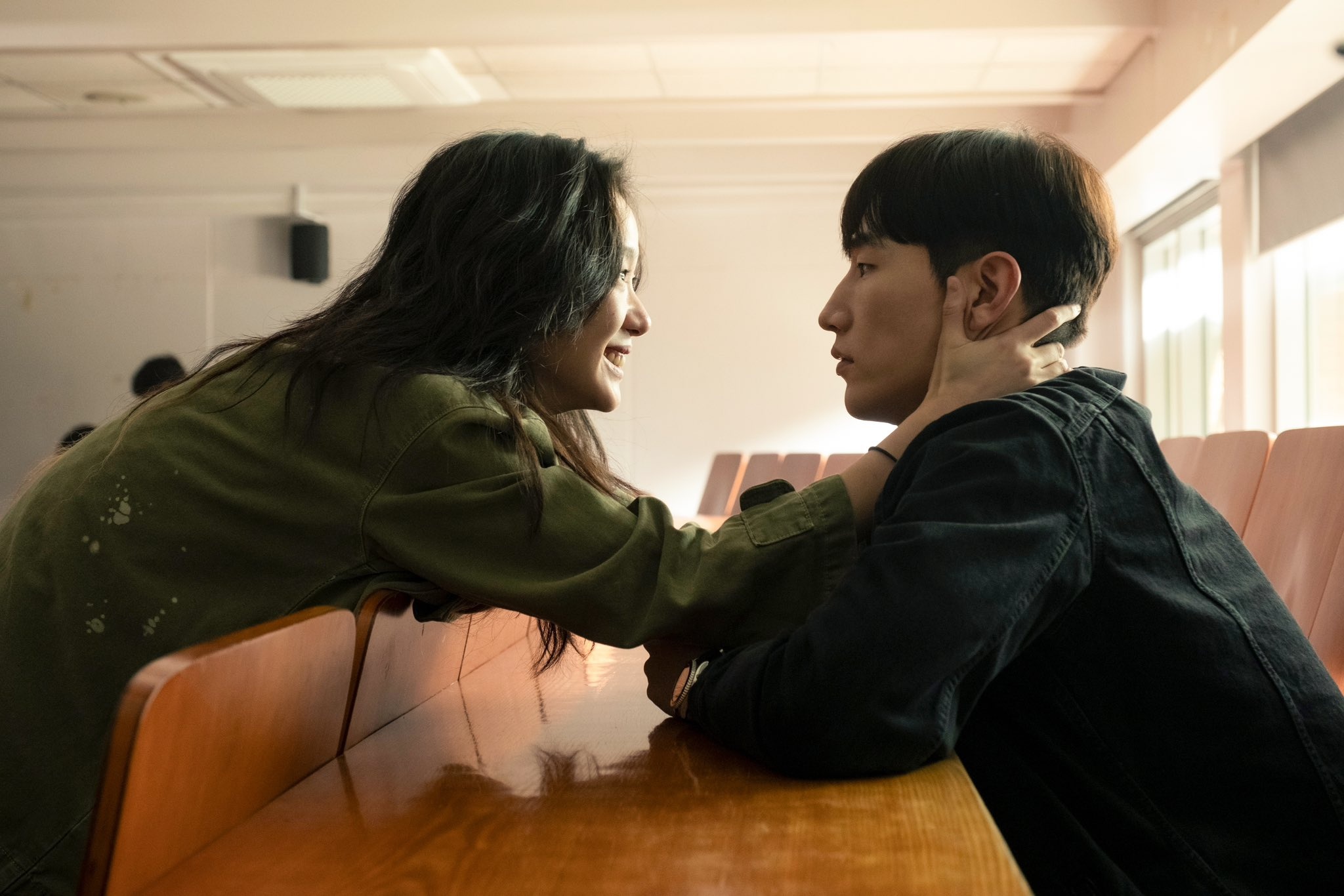
Thus begins a tell-tale of two friends who grow closer because of their adverse situations. When a pervert starts stalking Jae Hui, Heung Su moves into her apartment and thus begins their rambunctious cohabitation. There cannot be two people who are as different as the day and night. Jae Hui is a hopeless romantic, and she always falls for the wrong guy (even though Heung Su keeps warning her about them). As a closeted man, Heung Su’s lifestyle is different. He does find a kindred soul in a one night stand, Su Ho (Jung Hwi). While Heung Su is happy hiding inside the closet, Su Ho wants to be set free. Their tumultuous relationship actually represents the fate of most queer population in countries where homosexuality is still considered as taboo. Once, Su Ho invites Heung Soo to a club meeting without informing him that it is a Pride event. There, their event is vandalized by homophobic fanatics and Heung Soo gets hurt. They have this deeply meaningful conversation where Su Ho expresses his desire to live freely but Heung Su accepts that he doesn’t have the guts to do so. Add to this, Heung Su’s family situation isn’t ideal for his “Coming Out” phase. Suspecting his son’s sexuality, Heung Su’s mother turns to religious discourse to cure her son. Unable to live the life he desires, Heung Su seeks comfort and solace in his best friend who is the only one to understand him. With time, Heung Su’s relationship with Su Ho dampens as he refuses to accept his sexuality or their relationship openly.

As years pass by, Heung Soo has to deal with the hard reality where Jae Hui has moved forward in her life and career choices, while he is still standing at the same place, stagnating and without much progress. Tensions escalate, when one day Jae Hui outs him in front of her hot-tempered boyfriend. Utterly appalled by her behavior, Heung Su returns home and in a moment of uncertainty, blurts the truth in front of his mother. He expects reproach or even disregard, but surprisingly, he receives acceptance. Spurred by her affirmation, Heung Su finds Su Ho again. Unfortunately, Su Ho has moved on and has a new boyfriend now. Later, after an adrenaline filled scene where Heung Su beats the hell out of Jae Hui’s ex-boyfriend for hurting her, they sit down and have a somber conversation. Heung Su tearfully accepts that he never reached out to Su Ho because of his own reservations; as such, he never told him how much he misses him. He took Su Ho for granted because he always around; Heung Su never thought that Su Ho would move on and seek new horizons. Heung Su breaks down while Jae Hui holds him as he cries bitterly.
Is it a Worthwhile Watch

I’m not sure how to articulate my thoughts about this movie!
I spend a lot of time comparing the drama and movie version; it’s inevitable. If you have watched the drama version and loved it; you might find that the movie version dulls in comparison. It isn’t as daring as the drama version in terms of its interpretation of queer culture. Yes, Heung Su’s problems, his hesitation and his turmoil does represent the masses, but a lot is lost in translation. It may be because the movie glosses over the queer elements and bypasses it, to focus solely on Heung Su and Jae Hui’s friendship. The movie is a “Coming-of-Age” story about two individuals who are struggling in their own ways. They find comfort and solace in each other while the world is against them or doesn’t understand them. Don’t go looking for pristine queer representation, especially Steve Noh’s portrayal pales in comparison to Nam Yoon Su’s impactful performance in the drama version. His rendition is merely reduced to acting like the gay guy who uses his female best friend as a front to hide his sexuality and stands beside her throughout all the bad decisions she makes. If you want to watch a movie that involves strong bonds of friendship, then “Love in the Big City” could be your go-to favorite; just don’t expect any hardcore queer romance that the drama showcases. You will be sorely disappointed!
Rating- 3.5 out of 5
Streaming on- Viki
 The BL Xpress