
Apologies for being four months late to this. Also, this is not exactly a spoiler-free zone.
Gap the Series
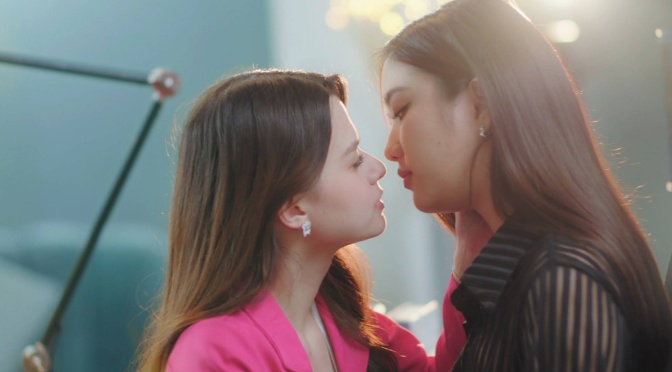
I’m sure one thing we can all agree upon is this—episodes 1 to 4 were certainly a prelude to the roller-coaster ride that was the rest of the series. We’ve got everything from a lesbian romance that knocks its viewers off their feet, hilarious and supportive friends, and colleagues who clown quite a bit, to drama in the guise of internalised (as well as overt) homophobia and generational trauma as a reflection of society at large.
The first few episodes deal with how Mon and Sam deal with the struggles of being a couple, such as the secret office romance, their age gap, class hierarchy, and money-related issues that highlight the power differences between them. The communication gap adds to these issues and is sometimes dealt with not strictly through healthy means until they talk it out together. If jealous Mon is pouty and cute, jealous Sam is mostly mean and a clown at her best and downright hurtful at her worst. However, it is evident that her terrible, misogynistic remarks directed at Mon reflect the society in which she was brought up, under the watchful eyes of patriarchy and, undoubtedly, her grandmother’s thumb.
You’d think that the antagonists would be Nop, with his crush on Mon and his harsh comments addressing her love for Sam before accepting that his love would remain unrequited and, thus, is a supportive friend till the end. Or Nita, who exudes significant bi energy, therefore, leaving viewers confused about whether they hate her or are extremely attracted to her (or both). You’d consider power imbalances created by divisions of class, age, and boss-employee relations, among other things, try to ruin Sam and Mon’s relationship. You’d even think that it’s Kirk, who’s an honestly terrible fiancé with his betrayal of Sam in so many ways—although she does end up keeping her relationship with Mon a secret initially. Well, he still is one, and an annoying one at that, right until before the series ends.
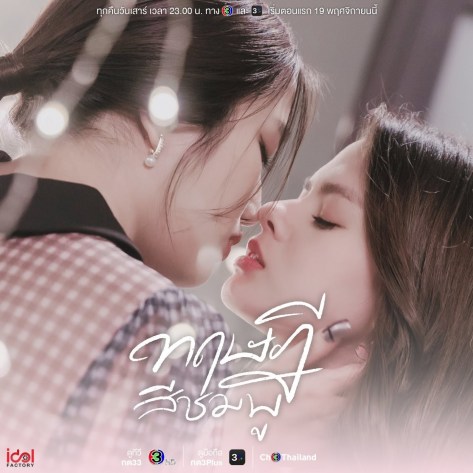
But he’s still a pawn in the hands of the main antagonist of the show—Sam’s homophobic and controlling grandmother, with the addition of annoying nosy older women who reinforce cis-heteronormative ideas. Through flashbacks of Sam’s past, we get a glimpse into the havoc wreaked by her grandmother, a product of a cis-heteronormative society, who constantly gaslights and manipulates Sam and her siblings to do her bidding. Neung, Sam’s oldest sister, leaves the family and becomes an artist. Song, the family’s second daughter, dies in a car crash when she leaves the house in response to her grandmother refusing to accept her relationship with her queer partner, Ice.
Song and Ice represent a crucial conversation still left unaddressed in many countries, including Thailand—that of laws regarding Queer marriage equality. These rights, which are taken for granted in marriage as an institution oriented towards cis-heterosexual relationships, don’t take into account that non-normative relationships and families also deserve these rights. These issues are brought up by Sam and Mon’s conversations with Risa and Cher, a happily married couple who run a queer-friendly holiday resort together. These two are indeed living the dream, and are placed in juxtaposition to SongIce and MonSam to show what life is like when people from queer communities are allowed to live their lives freely. Their relationship and the struggles to get to where they are at present also highlight how being openly queer is not very easy in the face of cis-heteronormative patriarchy.
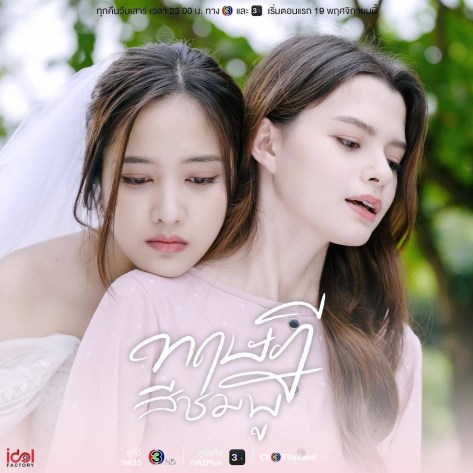
The protagonists, Mon and Sam, go through quite a growth in these episodes (a learning curve, if you will). This is true especially for Sam, as she strives to escape from her grandmother’s clutches to stay with Mon for life. She barely knows how to show her emotions openly when she begins falling for Mon. She becomes better at expressing herself as she breaks away from the generational trauma that has imprisoned her grandmother and her older sisters. While the series is messy and may be a bit too drawn out, it does end well for the lovers.
What I love the most is how the series address women’s pleasure, whether it is by the lovers themselves or Sam’s friends Tee and Jim—and surprisingly, Yuki, who would also have given us interesting bi representation, had her relationship with Tee been portrayed. We were promised TeeYuki, but we didn’t get them yet, so I’m assuming—season two, maybe? It would be great if the series had tried to explore their relationship in these 12 episodes, but one can’t really complain.
Filled with domestic moments, steamy romantic scenes, beach trips, a honeymoon phase, lots of drama, constant banter between the two protagonists, and conversations surrounding queer relationships in a queerphobic society, GAP the series does give us everything we’ve wanted. While the two leads sometimes appear a bit stiff when it comes to acting, they do have good chemistry and have definitely tried their best. I personally loved the friends and colleagues who clowned hard, Mon’s supportive parents, and the whole atmosphere of it all. It’s a great watch—maybe not something you’d obsessively watch repeatedly, but a fun watch nonetheless.
Marry Me
A rearranged version of the original OST of the series sung by Saint Suppapong Udomkaewkanjana and arranged by Paween Wongrat, “Marry Me” depicts FreenBecky as a lesbian couple in their honeymoon phase. The song, performed by the two actors themselves, was created in collaboration with Twelve Plus, a health and beauty brand in Thailand, and was produced by VelCurve House.
The song was set in various locations—a bedroom where domesticity was the highlight, a pool in which the girls frolicked together, and a TV room where they watched movies while feeding each other snacks. They seemed at ease with themselves and each other, almost like a recap of their time together in the series, which was great to watch. Freen looked livelier and more expressive than ever in her cute swimsuit and white dress, and Becky looked ethereal in her poofy blue frock and flowers on her face. They looked and sounded adorable together as well.
While the OST was cleared to be released on 20th May 2023, the producers faced a hiccup and had to take down the music video a few hours later due to issues with the mixing of the audio for the song. The song was later released on 26th May once the production issues had been solved, with an apology on the part of VelCurve for the inconvenience they’d caused.
Overall Rating: 4 out of 5
You’ll find both GAP the Series as well as the MV for “Marry Me” on YouTube (for free)! The final episode had been streamed a week earlier by fans who had purchased tickets to do so, while others waited an extra week to watch it for free. I do hope you enjoy watching them!

